

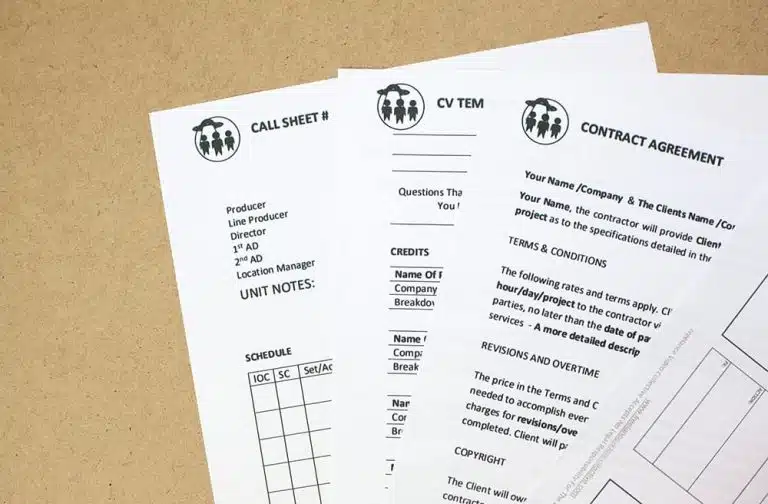

Making a film is an exciting creative journey. Legal documents for film production are essential to keep your creative journey on track because behind the cameras and lights, there are many important legal details that keep everything running smoothly. From scripts to locations, actors to music, every part of a film involves rights, permissions and responsibilities. Without clear legal documents, misunderstandings can cause costly delays, disputes or even stop a project altogether.
Whether you are an independent filmmaker, producer or part of a crew, knowing these basics will help protect your work, respect others rights and make your film production a success. Let’s dive into the essential paperwork that helps turn your story into a finished film.
The Importance of Legal Paperwork in Film Production
Film making involves many people, ideas, money, and rights. If things are not written down clearly then, misunderstandings happen. A legal document is like a map it shows who is responsible for what, what rights are given and how problems are solved. Using the right legal documents early can save time, money and stress.
1) Script Ownership Agreement (Writer–Producer Contract)
When a writer creates a story, screenplay, script or Film Rehearsals you need a contract to show who owns it and how it will be used. This document tells whether the writer sells all rights, licenses them or works under “work‑for‑hire.” It also states how much payment, deadlines and rewrites are handled. Items to include in this form:
- Names & Addresses: Of writer and producer.
- Script Info: Title, date, draft version.
- Rights Transferred: All limited rights, media, geography, duration.
- Payment Terms: Amount, advance, royalties, schedule.
- Delivery and Revisions: Deadlines, number of revisions.
- Credit: How and where writer will be credited.
- Warranties: Writer owns script, not copied or stolen.
- Termination: How and when contract can end, rights reversion.
SCRIPT OWNERSHIP AGREEMENT
This Agreement is made on [Date] between:
Writer: [Writer Name], address: [Address]
Producer: [Producer Name], address: [Address]
1) Grant of Rights
The Writer hereby grants to the Producer [all / limited] rights to the Script titled “[Script Title]” created on [Date of Draft]. These rights include [list: film, television, online, stage performances] in [territory].
2) Payment
Producer shall pay Writer a total sum of [Amount] payable as follows:
a) [Advance] upon signing this Agreement.
b) [Balance] upon delivery of final draft.
3) Delivery and Revisions
Writer delivers first draft by [Date]. Producer may request up to [Number] revisions, to be delivered by [Dates].
4) Credit
Producer agrees to credit Writer as “[Credit Line]” in all versions and promotions.
5) Warranties and Indemnity
Writer warrants ownership, originality, and that no existing work is infringed. Writer shall indemnify Producer from any claims.
6) Termination
Either party may terminate this Agreement if the other materially breaches and fails to cure within [Days] after written notice.
IN WITNESS WHEREOF, both parties sign below:
____________ ____________
Writer Name Producer Name
Date: _ Date: _
2) Talent Release Form (Actors / On‑Camera Persons)
A Talent Release Form is a document where anyone who appears on camera or gives voice explicitly gives permission to use their likeness, voice or performance. Without this, you may not legally distribute or exhibit the dramatic monologue for the film containing their work. Items to include in this form:
- Name of talent and production.
- Description of performance or appearance.
- Rights granted (photo, video, audio, voice).
- Territory and duration (how long and where you can use it).
- Compensation if any.
- Whether minors are involved, parental approval.
- Signature and date.
TALENT RELEASE FORM
Producer: [Producer Name], address: [Address]
Talent: [Talent Name], address: [Address]
For good and valuable consideration, the undersigned Talent grants to Producer the right to use Talent’s image, voice, performance, and likeness in connection with the film titled “[Film Title]”.
1) Grant of Rights
Producer may record, edit, dub, reproduce, distribute, display, and otherwise use Talent’s performance in film, marketing and promotion in all media worldwide, in perpetuity.
2) Compensation
Talent shall be compensated as follows: [Amount / “no compensation” if voluntary].
3) Minors
If Talent is under 18 years, a parent or legal guardian must sign below.
4) Releases and Indemnity
Talent warrants that Producer’s use will not violate any rights. Talent agrees to hold harmless Producer against claims arising from Talent’s breach.
Talent Signature: ___________ Date: __
Parent/Guardian (if minor): ___________ Date: __
3) Location Release Agreement
Before filming at any private or public place, you need permission. A Location Release gives legal clearance to film in a particular place and control over how it looks, to avoid problems later when you distribute the film. Items to include in this form:
- Names of property owner and producer.
- Address of location.
- Dates/times when access is allowed.
- Areas of property that are off-limits or allowed.
- Responsibilities (clean up, damages, restorations).
- Compensation or fee.
- Insurance or liability terms.
LOCATION RELEASE AGREEMENT
This release is made this [Date], by and between:
Location Owner: [Name], address: [Address]
Producer: [Name], address: [Address]
Location: [Description and Address of Location]
1) Permission to Enter and Use
Owner gives Producer and its cast, crew access to the Location on [Dates] during [Times] for filming and related uses.
2) Areas Covered
Producer may use [all / specified parts] of the Location. Areas not permitted: [list if any].
3) Clean‑Up and Damages
Producer agrees to leave the Location in original condition, paying for any damage caused during use.
4) Fee
Owner shall receive [Amount] for use of Location, payable [terms].
5) Liability and Insurance
Producer shall carry insurance and indemnify Owner against claims, damages, or injuries arising from Producer’s use.
Signature of Owner: __________ Date: _
Signature of Producer: ________ Date: _
4) Work-for-Hire and Contributor Agreements (Crew & Contractors)
Many people work on a film like camera, sound, costume, editing, graphics. Sometimes they are employees; sometimes contractors. A Work‑for‑Hire or Contributor Agreement says who owns the work done by them and under what conditions. Items to include in this form:
- Name and role of contributor (editor, composer, etc.).
- Scope of work: What exactly they will do, what deliverables.
- Payment, deadlines.
- Ownership: whether work is “hired” such that producer owns rights, or license with limits.
- Credit.
- Confidentiality if needed.
CONTRIBUTOR AGREEMENT
This agreement is on [Date] between:
Contributor: [Name], address: [Address]
Producer: [Name], address: [Address]
1) Services
Contributor will perform: [Describe tasks, e.g. sound editing / music composition / graphics] by [Deliverable due dates].
2) Payment
Producer pays Contributor a total of [Amount], payable [schedule].
3) Ownership of Work
All rights, title and interest in work, including copyrights, shall belong to Producer as work‑for‑hire. Contributor assigns any rights needed.
4) Credit
Contributor will be credited as “[Credit]” in film and promotional materials.
5) Confidentiality
Contributor may not disclose details of the project before release.
Signature of Contributor: ________ Date: __
Signature of Producer: ___________ Date: __
5) Confidentiality / Non‑Disclosure Agreement (NDA) for Film Ideas
Often ideas or scripts are shared with producers, investors or collaborators. A Non‑Disclosure Agreement keeps people from stealing or disclosing those ideas. Items to include in this form:
- Parties (who is disclosing, who is receiving).
- Definition of what is confidential (scripts, story lines, budgets).
- Purpose (why info is shared).
- Duration (how long confidentiality lasts).
- Exclusions (what is not confidential).
- Consequences for breach.
NON‑DISCLOSURE AGREEMENT
This NDA is entered into on [Date] between:
Disclosing Party: [Name], address: [Address]
Receiving Party: [Name], address: [Address]
1) Definition of Confidential Information
All material related to [Film Title], including script, story outlines, budget, cast lists, marketing plans.
2) Obligations of Receiving Party
Receiving Party shall keep confidential and shall not disclose or use Confidential Information except for purposes relating to evaluating or working on the Film.
3) Duration
This obligation continues until [Duration, e.g. 5 years] or until Confidential Information becomes public not through breach.
4) Exclusions
Information already known by Receiving Party, or independently developed, or publicly known through no fault of the Receiving Party, are excluded.
5) Remedies
Disclosing Party may pursue injunctive relief or damages for breach.
Disclosing Party Signature: ____ Date: _
Receiving Party Signature: ____ Date: _
6) Music Licensing or Synchronization Agreement
If you use songs, background music or any recorded sound you did not create, you need license from composer, rights owner or perform rights society. A Synchronization License lets you put music with picture. Items to include in this form:
- Name of licensor (owner) and licensee (your producer).
- Description of music (title, composer, publisher, duration).
- How you’ll use it (film, trailer, TV, online).
- Territory, duration, media formats.
- Fee or royalties.
- Credits.
MUSIC LICENSE AGREEMENT
This Agreement is made on [Date] between:
Licensor: [Name], address: [Address]
Licensee (Producer): [Name], address: [Address]
Track: “[Song Title]” by [Composer / Artist], duration approx. [Minutes/Seconds].
1) Grant of License
Licensor grants Licensee a non‑exclusive / exclusive license to use the Track in the film “[Film Title]”, including trailers, television, streaming, worldwide, for [Duration].
2) Fee / Royalties
Licensee pays Licensor [Amount] or [royalty terms].
3) Credits
Music shall be credited as follows: “[Credit Line]”.
4) Warranties
Licensor confirms they own or have rights. Licensee will be held harmless from infringing claims.
5) Termination
Failure to pay or breach of terms allows Licensor to terminate.
Licensor Signature: ________ Date: _
Licensee Signature: ________ Date: _
7) Extras Or Background Talent Release
People who just appear in background crowd, passers by, etc. also need release forms. Extras Release makes sure you can use the image of everyone in the scene without legal trouble. Items to include in this form:
- Name of extra (if known) or blanket consent if many.
- Description of what recording shows (crowd, busy street).
- Grant of rights similar to Talent Release, but usually simplified.
- Compensation (often small or none), region and media use.
EXTRAS RELEASE FORM
Producer: [Name], address: [Address]
Extra: [Name if known] / “All persons appearing in background scenes”.
By signing below, Extra grants Producer the right to use their image, likeness, voice in background or crowd scenes in the film “[Film Title]”, for all media, worldwide, in perpetuity.
Compensation: [Amount] / “Voluntary”.
Extra Signature (if applicable): __________ Date: __
8) Distribution Agreement
After you finish the film, distributing it involves agreements with distributors. A Distribution Agreement outlines how revenues are split, how the film is delivered, marketing, territories and duration. Items to include in this form:
- Names of Producer and Distributor.
- Rights granted (territory, media).
- Revenues, advance, percentage split.
- Delivery of film (formats, quality).
- Marketing and promotion obligations.
- Duration and termination.
DISTRIBUTION AGREEMENT
This Agreement is made on [Date] between:
Producer: [Name], address: [Address]
Distributor: [Name], address: [Address]
1) Grant of Distribution Rights
Producer grants Distributor exclusive / non‑exclusive right to distribute film “[Film Title]” in [Territories] in [Media: theaters, streaming, TV, DVD].
2) Payment Terms
Distributor pays Producer: [Advance / Minimum Guarantee] plus [Percentage] share of net receipts after expenses.
3) Delivery Requirements
Producer shall deliver final master copy in formats: [specs], with subtitles / dubbing as required [if applicable] by [Date].
4) Marketing & Promotion
Distributor to provide marketing budget: [Amount] or % of income. Producer may approve major promotional materials.
5) Term and Termination
Agreement lasts [Years or Period]. May be terminated if Distributor fails to meet performance obligations.
Signature of Producer: ________ Date: __
Signature of Distributor: ______ Date: __
9) Insurance Agreement and Indemnity Clarity
Film production involves risks like people can get hurt, equipment can be damaged and third parties injured. Insurance helps cover those. Indemnity clauses shift responsibility for certain losses. Although insurance policies are separate from agreements, you need to define in contracts who is responsible for what risk and liability. Items to include in this form:
- Types of insurance (general liability, workers’ compensation, equipment insurance, cast insurance).
- Who pays for insurance.
- Who is indemnified (protected against claims).
- Limits of liability.
- What happens if there is a loss or accident.
INSURANCE & INDEMNITY CLAUSE
In all agreements related to this film production titled “[Film Title]”:
1) Insurance
Producer shall procure and maintain adequate insurance policies including general liability, workers’ compensation, equipment insurance, and others as required by law. Coverage minimum: [Amount].
2) Responsibility for Costs
Producer bears the cost of insurance premiums. Each contracting party remains responsible for their own conduct under policy.
3) Indemnity
Each party (Producer, crew, contractors) agrees to indemnify and hold harmless other parties from claims, liabilities, damages arising from their negligence or breach of contract.
4) Limitations
Neither party shall be liable for incidental or consequential damages beyond [Amount] unless caused by willful misconduct.
Signed by all major parties: Producer / Contractors / Key Crew
_____________ Date: __
10) Completion Bond or Financing Assurance
When investors put money into a film, they may want a guarantee that film will be completed. A Completion Bond is a legal guarantee from a third party that the producer will finish the film as agreed. It gives confidence and helps secure financing. Items to include in this form:
- Parties: Producer, Bond company (or financier).
- Budget, schedule, how deviations are handled.
- What happens if production overruns budget or misses deadlines.
- Who bears extra costs.
- Consequences if film is not completed.
COMPLETION GUARANTEE AGREEMENT
This Agreement is made on [Date] between:
Producer: [Name], address: [Address]
Guarantor / Bond Company: [Name], address: [Address]
1) Purpose
Guarantor guarantees that the film “[Film Title]” will be completed in accordance with the approved budget of [Amount] and schedule ending on [Completion Date].
2) Oversight
Producer agrees to provide regular reports to Guarantor: financial, schedule, progress.
3) Budget / Schedule Overruns
If Producer overspends or delays beyond [Threshold % or Days], then Guarantor reserves right to intervene, inject funds, or require changes.
4) Remedies
If film is not completed, Guarantor may recover payments or enforce penalties.
Signature of Producer: _______ Date: __
Signature of Guarantor: ________ Date: __
Protecting Your Film Begins with the Right Documents
Film production is not just about creativity it’s also about clarity, trust and protection. Legal documents play a crucial role in making sure everyone involved knows their rights, responsibilities and what to expect. Whether you are working with writers, actors, crew members or locations, having the right agreements in place keeps your project safe from legal issues down the line.
The templates and explanations in this guide are designed to help you get started, but every production is unique. It is always wise to review your contracts carefully and consult with a legal professional when needed. By putting the proper legal documents in place from the beginning, you give your film the best chance of reaching the finish line smoothly and successfully.
Lights, camera, paperwork then action!