


A shot list is one of the most essential tools when planning a short film. Planning a short film takes more than just a great script. Once your story is ready, the next big step is figuring out how to bring each moment to life on screen. That’s where a shot list comes in.
A shot list is a detailed plan of every camera shot you will need and helping you stay organized. This saves time on set and make sure your vision is captured exactly the way you imagined.
How to Create a Shot List for Your Short Film, Step by Step Guide with Examples
Planning a shot list is one of the most important steps in pre production for any short film. A well organized shot list helps the director, cinematographer and crew visualize how each scene will be filmed. It saves time on set, avoids confusion and ensures that every shot is captured the way it was imagined from main footage, side shots, shooting B Roll and extra coverage.
What is a Shot List and its Anatomy?
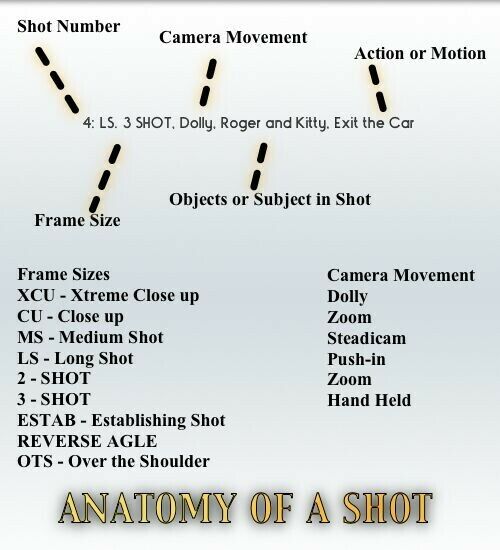
A shot list is a document that outlines every shot you need to film for a scene or entire film and it includes details such as:
- Shot number
- Scene number
- Shot type
- Camera angle
- Camera movement
- Description of the action
- Duration or estimated time
- Notes or directions
It is usually made by the director and cinematographer and it acts as a map for how the film will be visually told.
Going into a shoot without a shot list can cause a lot of problems. A shot list helps save time because you know exactly what to film and in what order. So, it keeps everyone on set organized and working together smoothly. It also makes planning easier by showing what equipment you need, when to change locations and when actors are needed.
A shot list helps tell the story the way you want, with the right mood and pace. Most importantly, it makes sure you don’t forget to film any important shots like close-ups or reactions.
When do I create a shot list?
You should make a shot list during pre-production, after your script is finished but before filming begins. First, this helps you plan how each scene will be shot. Then, you can share your ideas clearly with the crew, especially the camera team.
Next, it helps you stay organized and save time on set. Finally, it lets you find any problems early and make sure everything is ready before the shoot starts.
The workflow looks like this:

Simple Steps to Create a Shot List
Creating a shot list is easy once you have your script ready. Here is a step by step guide to help you build a complete and professional shot list.
Step 1: Break Down Your Script
Start by reading your script scene by scene. Identify key actions, emotions and moments that will need to be captured on camera and ask yourself:
- What is the purpose of the scene?
- What should the audience feel?
- Are there any special visual cues or symbols?
Highlight any action, dialogue or emotional beats that need coverage. This gives you a clear idea of what shots you will need.
Step 2: Choose the Right Shot Types
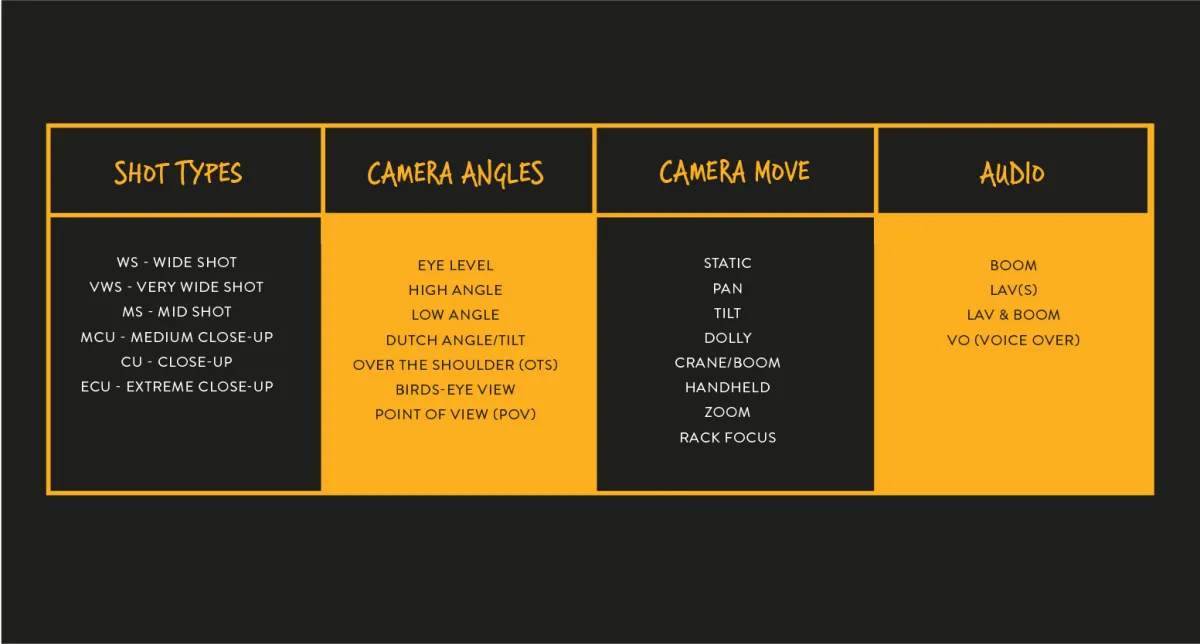
Now that you know what is happening in the scene, think about how to visually present it. Choose the right shot types using film composition rules to match the mood and story of each scene and here are common shot types to use:
- Wide shot (WS): Shows the environment and full body of characters.
- Medium shot (MS): From waist up, good for dialogue.
- Close-up (CU): Focus on face or object, great for emotion.
- Extreme close-up (ECU): Very tight shot on detail (eyes, hands, etc.).
- Over-the-shoulder (OTS): Used in conversations.
- Point-of-view (POV): Shows what a character sees.
- Tracking shot: Follows a character’s movement.
- Static shot: Camera stays still.
- Handheld shot: Adds realism or tension.
Step 3: Select Camera Angles and Movement
Once you know the shot type, decide how the camera should be positioned and whether it moves. Choosing the right angles and movements helps tell the story emotionally and visually.
- High angle: Looks down on the subject, makes them look small or weak.
- Low angle: Looks up, makes subject seem powerful.
- Dutch angle: Tilted shot for disorientation or tension.
- Static camera: Calm and controlled.
- Pan: Moves camera side to side.
- Tilt: Moves camera up or down.
- Dolly: Moves camera forward or backward smoothly.
- Crane or drone: For aerial or elevated shots.
Step 4: Write the Description of Each Shot
Write a short, clear description of what happens in the shot. For Example:
“John opens the door and slowly walks into the dark room. He looks around nervously.”
Be specific. Mention character actions, important props, or camera behavior. This helps your crew understand what they are filming.
Step 5: Organize the Shots Logically
Try to group shots based on camera setup or location to save time during production. For example, shoot all scenes in one room together, even if they appear at different times in the story. Now organize your shots by:
- Scene number
- Shot number
- Shooting order not always same as script order
- Location
Step 6: Add Notes and Special Instructions
This helps the crew prepare and avoid surprises and include extra notes like:
- Lighting style
- Audio requirements
- VFX if needed
- Props or costumes needed
- Time of day if shooting outside
Shot List Template for Beginners
| Scene | Shot Number | Shot Type | Description | Camera Angle | Camera Movement | Location | Time of Day | Talent | Notes |
|---|---|---|---|---|---|---|---|---|---|
| 1 | 1A | Wide Shot | Establishing the street outside the café | Eye-level | Static | Café Exterior | Morning | John, Sarah | Include background traffic |
| 1 | 1B | Medium Shot | Sarah walks toward café entrance | Over-the-shoulder | Tracking | Café Exterior | Morning | Sarah | Follow from behind |
| 1 | 1C | Close-Up | John’s reaction as he sees Sarah | Eye-level | Static | Café Interior | Morning | John | Hold for 3 seconds |
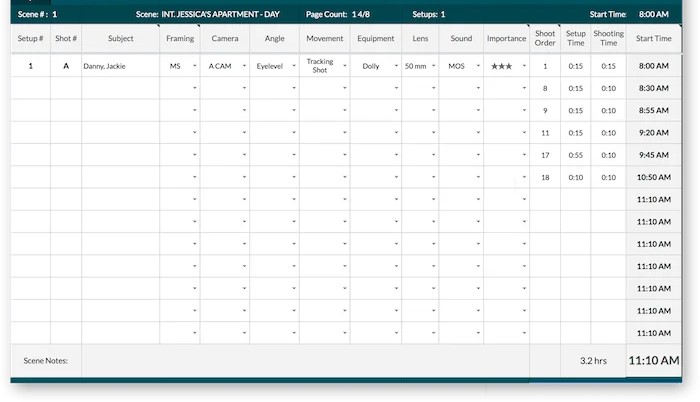
Make sure your team has a copy during the shoot. You can add more columns like:
- Duration (estimated time of shot)
- Camera (which camera/lens to use)
- Audio (dialogue, ambient, etc.)
- Equipment (tripod, dolly, drone)
Real Shot List from a Short Film
Let’s imagine a short film titled “The Letter” a 5 minute drama about a woman who finds a letter from her long lost brother.
Scene 1: Bedroom – Morning
- Shot 1: Wide Shot – Eye-level – Static
Sarah lies in bed, light shining through the curtains. She slowly opens her eyes.
Location: Bedroom
Notes: Use natural morning light. - Shot 2: Close-up – Eye-level – Static
Her hand reaches out to the nightstand and grabs a dusty envelope. - Shot 3: Insert Shot – Top-down – Static
Camera focuses on the envelope: “From James” is written in shaky handwriting. - Shot 4: Medium Shot – Side angle – Dolly in
Camera slowly moves in as Sarah reads the letter silently, tears forming in her eyes.
Scene 2: Flashback – Park – Afternoon
- Shot 5: Wide Shot – High angle – Drone
Young Sarah and her brother run through the park laughing. - Shot 6: Close-up – Eye-level – Handheld
Young James says, “Promise me you’ll always remember me.”
Scene 3: Present – Living Room – Evening
Shot 7: Medium Shot – OTS – Static
Sarah folds the letter and places it in a box filled with old photos.
Shot 8: Extreme Close-up – Top-down – Static
Camera zooms into a photo of her and James as children.
Turn Your Vision into a Visual Plan
Creating a shot list might seem like extra work, but it is actually one of the most powerful tools you have as a filmmaker. It turns your script into a clear visual plan, keeps your crew organized and helps you make the most of your time and resources on set.
Whether you are filming with a big team or just a few friends, a well prepared shot list ensures you don’t miss any important moments — and that your film looks exactly the way you imagined. Start with the basics, use the template provided and adjust it to fit your style and needs.
Remember that great films do not just happen in the moment they are planned shot by shot.
Happy shooting!